Built from 7 years of ecommerce CFO experience

Stop guessing your P&L.
Model it.

The Financial Game Plan projects your profitability and cash flow from the levers you actually control - nCAC, retention, and AOV. Built for DTC operators who need answers, not assumptions.

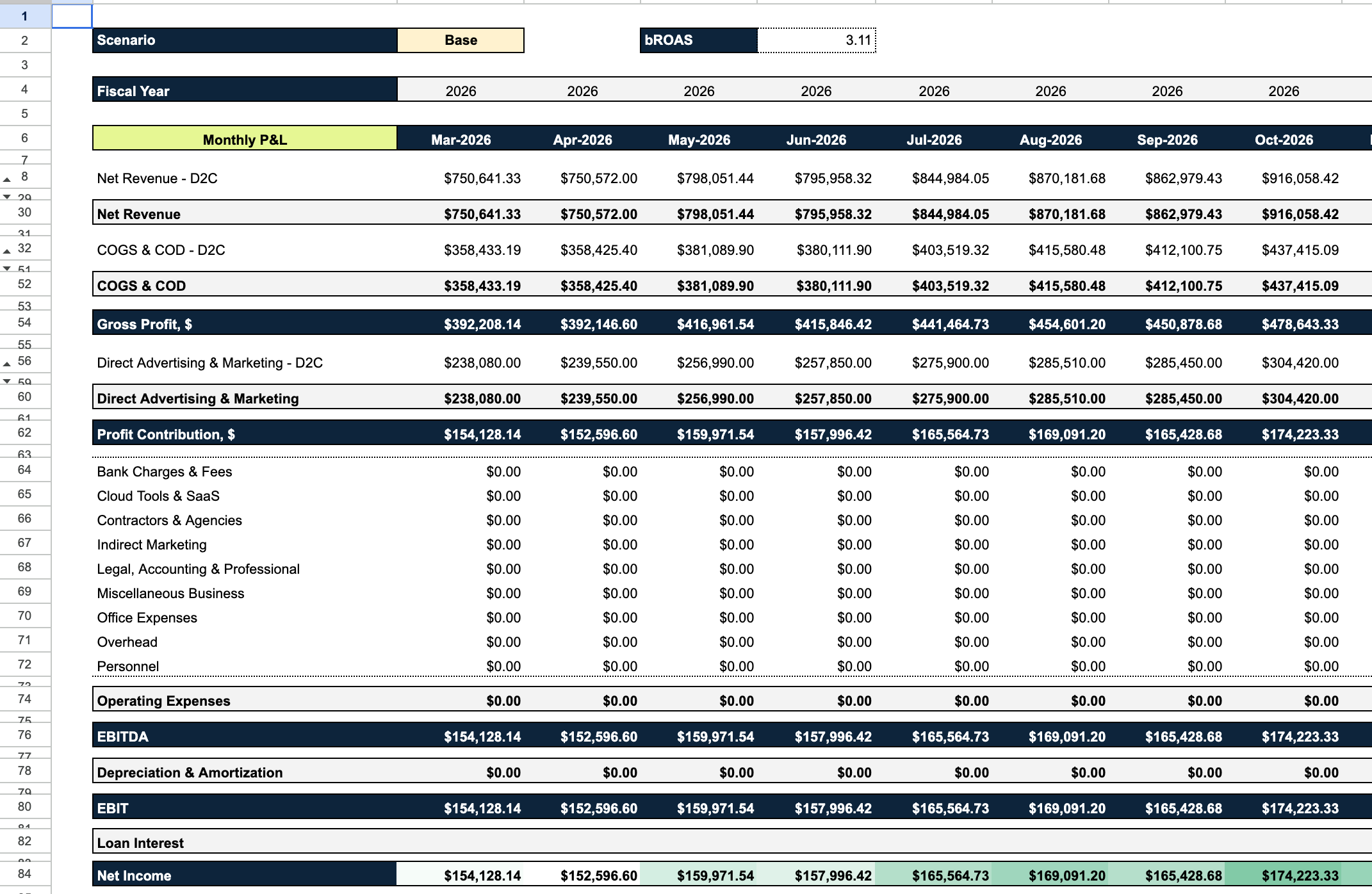
Financial Game Plan - Projected P&L
Financial Game Plan - Projected P&L showing monthly revenue, COGS, gross profit, and profit contribution projections

Your P&L says one thing.
Your bank account says another.

Most DTC brands plan with high-level revenue targets and fixed margin assumptions. That works until you try to scale - and the cash doesn't follow the spreadsheet.

📉
Scaling spend doesn't scale profit linearly
Efficiency decays as you increase budgets. A brand spending $500/day on Meta will see 10-40% higher nCAC at $1,000/day - but most forecasts assume flat acquisition costs.
💸
Profitable on the P&L, broke in the bank
Front-loaded inventory purchases, delayed Shopify deposits, and payment processing timing mean your cash flow can diverge wildly from your accrual P&L.
🔮
YoY projections hide the real story
Top-down forecasting treats your business as one number. It can't tell you what happens to margins if retention drops 5% or if you shift product mix toward lower-COGS SKUs.

Three inputs. Complete visibility.

The model is built around the three levers that actually drive DTC profitability - nothing more, nothing less.

1

Input your unit economics

Product data, AOV, and variable costs. The model calculates weighted COGS and margins by new vs. repeat customers automatically.

Flexible: Use modeled inputs (build from components) or decision inputs (plug in your known numbers). Switch between modes anytime.
2

Model acquisition and retention

Set your nCAC with Meta/Google budget splits, then apply efficiency decay to model diminishing returns at scale. Map your 12-month repurchase rates.

Realistic: The decay factor (0.15-0.4) ensures your forecast accounts for how efficiency worsens as you spend more - something flat models ignore.
3

See your projected P&L and cash flow

Daily revenue model with new + repeat customer segmentation. Monthly P&L across scenarios. 13-week cash flow including inventory, deposits, and payables.

Actionable: Change any lever and watch the entire model update. See base, worst, and best case scenarios instantly.

Six components. Every lever that matters.

Each component can run in modeled mode (build from detailed inputs) or decision mode (plug in your numbers directly).

01

Product Data

SKU-level pricing, COGS, and sales distribution by new vs. repeat customers. Changing your product mix dynamically updates AOV and margins.

Drives AOV + COGS
02

AOV Modeling

Modeled: blended discounts, refund allowance, shipping revenue, units per transaction. Or plug in a decision AOV and skip the detail.

Modeled or Decision
03

Variable Costs

Unit COGS (derived from product mix), fulfillment and carrier fees per order, and payment processing (2.9-4% depending on BNPL volume).

Auto-calculated from product data
04

nCAC + Efficiency Decay

Model acquisition cost from Meta/Google CPMs, CTRs, and conversion rates. Apply a decay factor (0.15-0.4) to forecast how nCAC worsens as spend scales.

The lever most brands ignore
05

Retention Data

Map repurchase rates across 12-month windows. Or use Shopify's return customer rate for a simpler view. Retention compounds - this is where growth lives.

12-month repurchase windows
06

Daily Revenue Model

Combines all five inputs into daily projections. New + repeat customer orders, monthly P&L, base/worst/best scenarios, and a 13-week cash flow forecast.

P&L + 13-week cash flow
From inputs to decisions

Every component feeds forward. Change one lever and the entire model recalculates - P&L, cash flow, and scenarios.

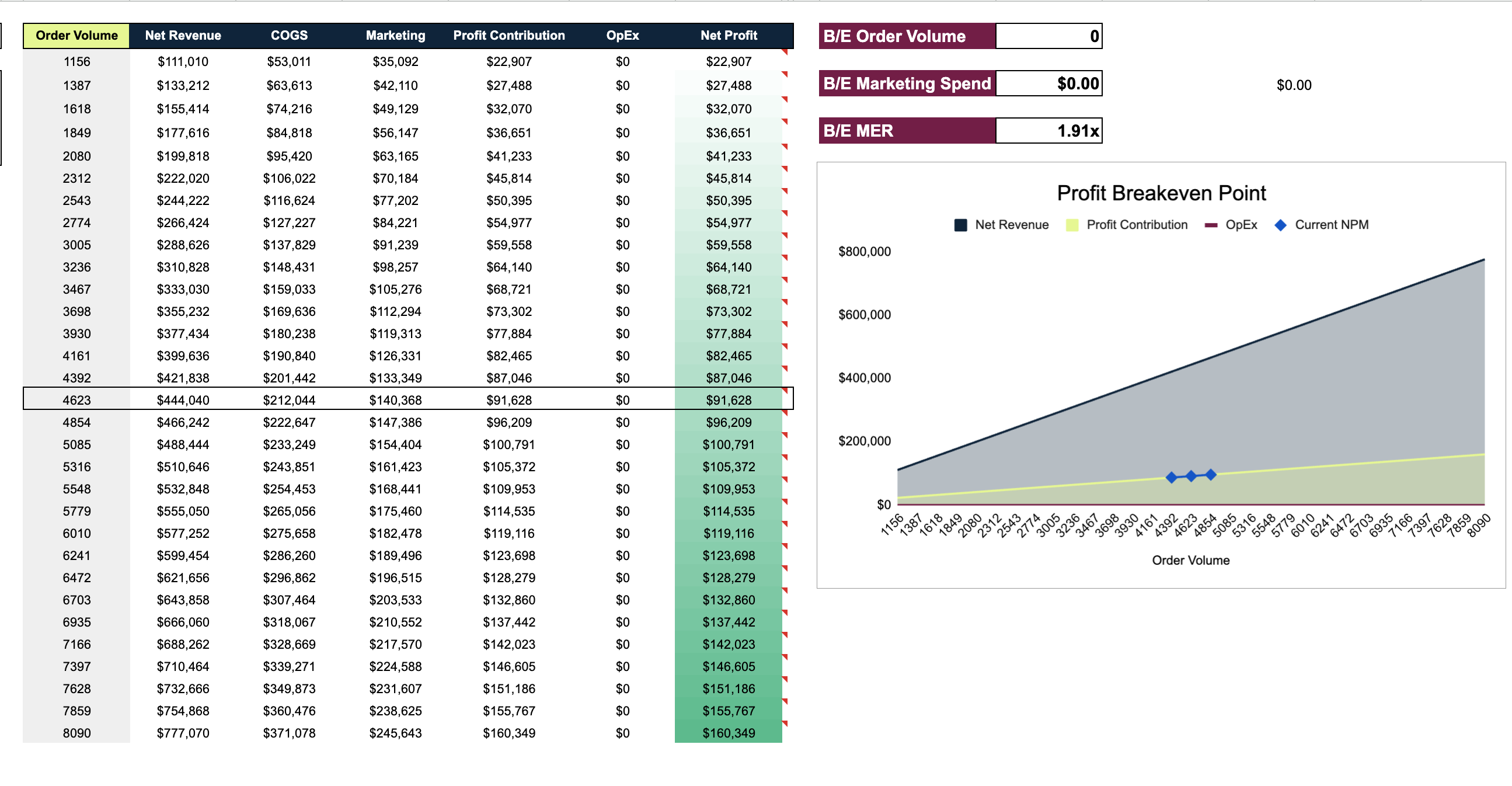
Financial Game Plan - Profit Breakeven Analysis
Profit Breakeven Analysis showing breakeven chart, MER sensitivity table, and order volume projections
Your inputs
Product Data AOV Variable Costs nCAC + Decay Retention
The engine
Daily Revenue Model Scenario Planning
Your outputs
Projected P&L 13-Week Cash Flow Base / Worst / Best

Three ways to get started

Join the community, get a custom Financial Game Plan, or bundle both for the best value.

Tier 1
MTN Community
Master the fundamentals of DTC finance
$119 / month
Or $1,000/year (save $428)
  • Financial Toolkit (diagnostics suite)
  • Bi-weekly live workshops with Nick & Val
  • Community of DTC operators
  • Weekly Q&A calls
  • Case study deep dives
  • Upgrade to FGP when you're ready
Learn More
Standalone
Financial Game Plan
One-time engagement with Val
$2,500 one-time
Custom analysis and model configuration
  • Financial Game Plan configured for your business
  • Unit economics analysis by Val
  • Benchmark ranges sheet
  • One walkthrough session
  • No ongoing support or updates
  • No community access
Book a Call

Built by operators, for operators

The Financial Game Plan comes from the same methodology used to advise 8- and 9-figure DTC brands.

Valentin Kuznetcov
Valentin Kuznetcov
Fractional CFO & Co-Founder
Creator of the Optimal Numbers program. 7+ years advising DTC brands on unit economics, cash flow management, and financial strategy. The Financial Game Plan is the model Val uses with his own clients.
Nicholas Miller
Nicholas Miller
Growth Operator & Co-Founder
Former Head of Traffic at Tier 11 with $200M+ in managed ad spend. Bridges the gap between marketing execution and financial outcomes - translating CAC, LTV, and MER into actionable growth strategy.

"The same forecasting methodology used in the Optimal Numbers Program - adapted for operators who want to control their own numbers."

Know your next 13 weeks
before you spend a dollar

Stop planning from revenue targets. Start planning from the levers you control - nCAC, retention, and AOV. The Financial Game Plan shows you what happens next.